Blue Team

Virtual SOC
A realistic operations floor with SIEM console, alert queue and case handling. Labelled attacks unfold on a timeline while Tier 1, Tier 2 and lead analysts work one queue, scored on accuracy and speed.
Eight ways to train
From tier-1 analyst to red-team operator, every role gets a purpose-built arena.
Blue Team
A realistic operations floor with SIEM console, alert queue and case handling. Labelled attacks unfold on a timeline while Tier 1, Tier 2 and lead analysts work one queue, scored on accuracy and speed.
Blue Team

A data lake seeded with hidden adversary tradecraft: living-off-the-land, lateral movement, persistence and exfiltration. Hunters pivot across entities and are graded against a ground-truth answer key.
Leadership

Branching ransomware, breach and insider scenarios where each decision shapes the next inject. Teams join from any browser. Decisions, timing and rationale are captured for the debrief.
Red vs Blue

Multi-host enterprise networks attacked by an automated adversary engine running full kill chains. A live scoreboard tracks detection, containment and uptime. A CTF engine runs attack-defence events.
Purple Team

An ATT&CK-mapped emulation library from initial access to impact, safe by design and wired to SIEM and EDR, so teams validate detection coverage technique by technique.
Red Team

Exploitation and C2 frameworks, multi-platform payloads, graded vulnerable machines and a web-app testing toolkit for OWASP Top 10 and API attacks, all fenced inside the range.
DFIR

Memory forensics, super-timelines, packet capture and network monitoring, plus static and dynamic malware analysis, with seeded evidence and automated grading.
Learning
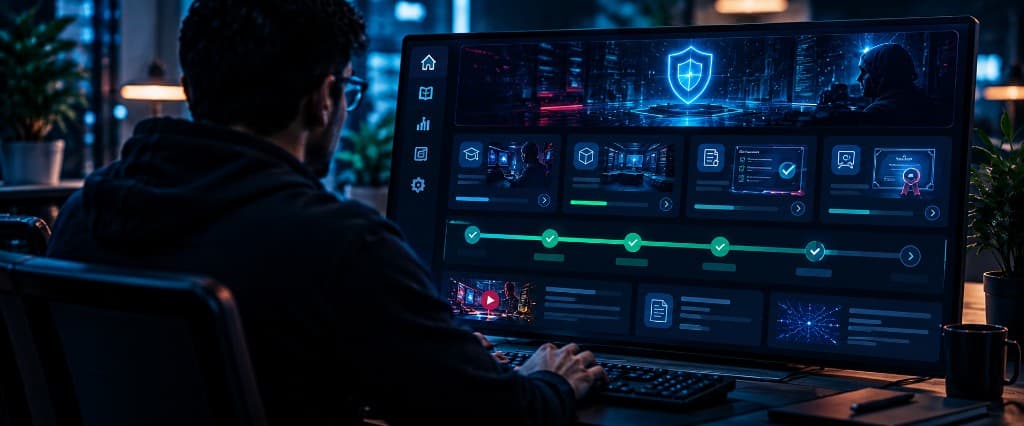
SCORM and xAPI courses, videos, quizzes and certificates. Labs and CTFs launch inside each course, and scores flow straight into gradebooks and competency maps.
Learners who want a structured course can follow the Advanced Program in Cyber Security, a 4-month hybrid program after Cyber Security Fundamentals.